

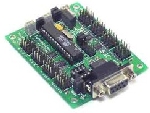
Lynxmotion SSC-32
The Lynxmotion SSC-32 module allows you to interface RoboRealm to servos using a controller made by Lynxmotion called the SSC-32 Servo Controller. The servo controller supports up to 32 channels of 1uS resolution. In addition the board provides synchronized movement so that all servos will update at the same time. The board also supports 4 digital or analog inputs for adding additional sensors to your robotic projects.
Interface
Instructions
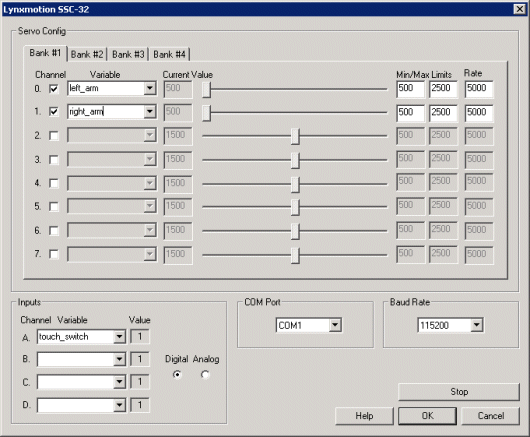
1. COM Port - Select the COM port that the controller is connected to on your computer. Note that you will only see COM ports that are recognized by your computer.
2. Baud Rate - Select the appropriate baud rate. Note that 115200 is the default and should not be changed unless required. For instance, if you are using the controller board through a wireless connection you may need to slow down the connection speed due to the wireless hardware limitations. Be sure to also change the jumpers on the Lynxmotion SSC to reflect the desired rate.
3. Checkbox - To enable/disable a particular servo channel select the checkbox to change its state. When disabled the servo will not be sent any further position commands.
4. Scroll Bars - After specifying the COM port and speed you should be able to move your servos by dragging the sliders to the right or left or by specifying a number within the current value text box in the Servo Config area. If the servos do not move check your COM port setting and/or board connections. You should see a small green light flash on the Lynxmotion SSC board when any serial communication is present. If you do not see this light flashing when moving the scroll bar around check your connections. If you do see a flashing light with no movement check the channel you plugged the servo into.
5. Variable - Select an appropriate variable that contains or will contain the position value that will be sent to the servo board. This is used to automatically change the servo values based on your VBScript (using the SetVariable function) or Plugin based program.
6. Min/Max Limits - You can use the min/max limits to ensure that even if the variables specify large or low values (due to programming errors) that the board does not actually attempt to move the servos above or below the specified limits. This can be used as an additional precaution in case your servos cannot physically move beyond certain limits.
7. Rate - specify the speed at which your servos should move at. Note that once a new value is sent to the board the old position and speed will be overwritten.
8. Bank # - Select the appropriate bank of servos that you would like to configure. Note the channel number which corresponds to the channel number of the Lynxmotion SSC board. Only eight channels are visible at any time.
9. Inputs - select which type of input you wish to receive. Digital will set a one or zero. Analog will set a number between 0 and 255 depending on the voltage across the pins. By selecting or typing in a variable next to the appropriate input channel you can access that variable's value in other modules such as the VBScript or Write_Variables modules.
10. Press STOP if you need to quickly disable all the servos and return them to the middle or neutral (1500) position.
Note that if you set a servo channel to be positioned using a variable's value you will lose manual control over that servo. Changing the variable value, however, will change that servo's position.
The Lynxmotion SSC has servo position feedback information that is used to update the RoboRealm servo variable (if specified) based on where the servo currently is. As the servo rate can be changed the servo may not immediately adjust its position to the final destination but slowly move towards it. During this movement the servo variable within RoboRealm will be updated to reflect the current position of the servo. This can be used in successive VBScript or If_statement modules to change the behavior of the servo prior to completing the full move. Thus be aware that after the Lynxmotion_SSC module the servo variables may not have exact the values specified before the module is executed.
Example
 Click here
to load a configuration to move a servo in response to movement in front of the camera. Click on the
previous link. This should run RoboRealm and start processing images. Be sure that the camera button is pressed and
you have a webcam attached to your computer. If you see a black screen check the Options button and select
an active camera in the dropdown list.
Click here
to load a configuration to move a servo in response to movement in front of the camera. Click on the
previous link. This should run RoboRealm and start processing images. Be sure that the camera button is pressed and
you have a webcam attached to your computer. If you see a black screen check the Options button and select
an active camera in the dropdown list.
Ensure that the Lynxmotion servo controller board is connected to the computer. If you are using a different COM port than COM1 double click on the Lynxmotion_SSC module in the main RoboRealm dialog and change the COM setting in the interface that appears. Press ok to close the dialog.
Try waving your hand in front of the camera. Notice the green COG box tracking your hand. The servo should also move in one direction and in the other when you move your hand back. Note that when you stop moving your hand the picture disappears and the servo remains stable.
Click on each of the modules to see how we accomplished this task.
See Also
SSC
For more information
Lynxmotion SSC-32 Servo Controller
| New Post |
| Lynxmotion_SSC Related Forum Posts | Last post | Posts | Views |
 lynxmotion ssc 32U not connecting
Hi, We are experiencing some major trouble connecting the Lynxmotion module to the COM port. | 9 year | 4 | 4188 |
|
Servo controller
Hi, We where wondering if instead of using a parallax server controler as we cannot find where to ... |
9 year | 2 | 3240 |
|
PIck and place
Hello, I have a Lynxmotion AL5D, managed to get it connect and working. However, now I would like it to do cool st... |
12 year | 3 | 3667 |
 marble maze
question. in this tutorial of marble maze. what are the type of servo motor is used? ... |
13 year | 7 | 5330 |
|
Lynxmotion SSC-32
2 Questions: 1. Once I build a robo file and add in the Lynxmotion SSC module I have to... |
14 year | 4 | 3889 |
 Multiple SSC-32 modules in
I’m currently working on a project that would require 100+ servos (a lot I know!!!) and was wondering if it was possible to use... |
14 year | 4 | 4752 |
|
Changing Servo speed from VBScript
HI, I’m working with VBScript module sending variables to Lynxmotion_SSC but I don’t know how to change the servomotor speed fro... |
15 year | 3 | 5075 |
|
Servo Reversing
Hi there, I just hooked up an SSC 32 servo controller board. seems to be working well. | 16 year | 5 | 5551 |
|
Lynxmotion loses communication with roborealm
I'm having an issue with the lynxmotion SSC. It's been working for a while, but this evening when I powered up my robot, the l... |
17 year | 4 | 5201 |
|
lynxmotion w/ roborealm
Hi guys, I have a project to integrate roborealm with lynxmotion. In the project, I will have a camera to overlook four differen... |
17 year | 7 | 5166 |
|
Lynxmotion Python Control
Is there by chance any python API that I can examine to see how to control servos using the Lynxmotion SSC-32 servo controller.... |
17 year | 2 | 5230 |
|
Lynxmotion Robot
Guys and Girls I am happy with Roborealm, its great and i have happily processed my blue ball from... |
17 year | 3 | 5077 |